Vampires are sexy.
Complain about Twilight all you want, but sexy is their thing. Every movie monster that has multiple successful iterations (and in some cases have been beaten to death, looking at you zombies) represents some society-wide fear and taps into it for the shivers. Vampires represent sexual fears, often the fear of rape or loss of control. You can see it most clearly in older iterations like Dracula, which is a very straightforward psycho-sexual analysis of the human condition. But the world is a little more complicated now than it was in Bram Stoker’s time, so the fears vampires represent are also more complicated, and in my opinion, more interesting.
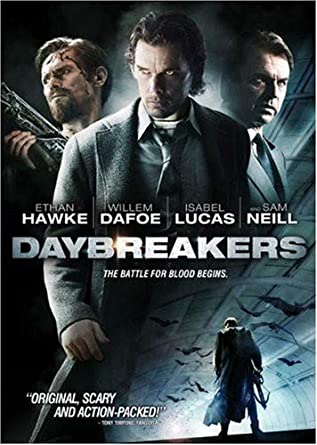
Daybreakers is a modern dystopian take on vampire mythology. Ten years into the future, a vampire infection has taken over most of humanity, and the straggling survivors are being hunted and farmed for blood. Edward Dalton works for a major corporation as a researcher trying to create a blood substitute that will feed the vampire population without destroying the humans. He never wanted to be a vampire and feels sorry for humans; his motivation is mostly altruistic. Over the course of the film he realizes two things: firstly, that the corporation he works for is anything but altruistic, and also the substitute isn’t necessary. There is a cure for vampirism, and Dalton becomes the mastermind behind perfecting it.
As vampire movies go, it’s more or less flawless. It hits all the important tropes: the vampires burn in sunlight, can’t see themselves in mirrors, and can go from dapper sex symbol to ravening bat-like beast in 0.2 seconds. Fans of traditional vampire lore will find little to complain about. The upper-class vampires dress as though they’re heading to a speakeasy: walking and speaking in a cultured way that completely ignores the disaster looming just out of sight. The starving vampires, called “subsiders,” are captured and bundled out of sight so as not to offend the privileged vampires’ delicate sensibilities. When there are too many subsiders to contain, they’re chained to trucks and dragged into the sunlight to be euthanized. Not TOO subtle of a message there.
The visual aesthetic is stunning. The film has two different looks; the world of the vampires is stark and low-lit, almost black and white. (Fans of Dark City will notice a family resemblance.) The world of the humans, on the other hand, is warm and golden, filled with the colors of an early summer morning. The “sunrise” feel of the human side is deliberate, I suspect, suggesting the dawn of a new era. The cast is flawless. Sam Neill is a human treasure, and Ethan Hawke plays the tortured sexy protagonist to a tee. Even Willem Dafoe is kind of hot in this one.
As far as symbolism goes, there’s a lot of unpack. Because it’s futuristic dystopian, you should expect a lot of commentary about society, and what makes this movie so much fun is the myriad of ways that it can be interpreted. What are the vampires, really? Are they one percenters? Are they the for-profit health care industry, feeding on the sick and driving their customer base into the grave with exorbitant prices? Healthcare is hardly the only social issue plagued with unsustainable practices. Daybreakers is so full of detail and subtlety that one could watch it over and over again and come up with a different answer each time.
This brings us back to my initial point: vampires are sexy. Even Dalton, the reluctant vampire who refuses to drink human blood, dresses as though he’s auditioning for a ZZ Top video and walks like he’s moving in slow motion even when he’s not. Vampires represent sexual fears–and sexual desires. That’s why my favorite hypothesis about the symbolism of the Daybreakers vampires is they represent the traditional concept of sex as a struggle for dominance.
In American society, our language and culture is steeped in the concept of sexual dominance. “Pussy whipped” is what we call a man who lets his lady make decisions for him. “Make them your bitch.” “Grow some balls.” “I got raped in the wallet.” Sex is seen as transactional, usually between unequal power dynamics. The “male” role is dominant; the “female” role is submissive. These are all outdated, archaic concepts that nevertheless many people cling to who fear change and fear the loss of social dominance. The Daybreakers vampires know that there is a blood shortage and that their way of life is unsustainable, but the majority don’t know that there’s an alternative. The few who do want to kill the alternative and drive it underground, because even if it meant a better life for them, it would remove their illusions of superiority. With all their beautiful homes and fancy cars that can seal out light to drive in the daytime, the vampires are clinging to an illusion that will destroy their entire species.
Sex does not have to be a power struggle, and making it one is unsustainable for relationships and personal happiness. Sex should be exchanged between equal individuals, with no assumptions of superiority or ownership. If a sexual exchange is monetary in nature, then that too should take place between equals, freely and with enthusiastic consent. If monogamy is the goal, then that too should be an understanding between equals, without suspicion or control entering into it.
Dalton approaches humans as one approaches an equal, not as a predator approaches prey. By doing so he opens the door to saving both himself and the rest of the dying population. Others can do the same, and they can be free and walk under the sun again.
 Dawn Napier