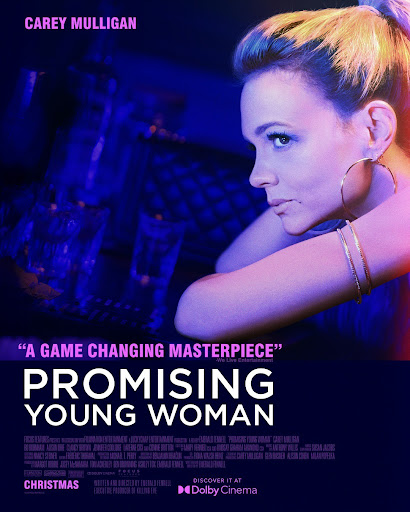
Promising Young Woman is one of the most thought-provoking horror movies I’ve seen since Get Out. There is so much to unpack here that I didn’t feel comfortable trying to squeeze it into a single post. So here is Part 2 of my review. And I know I said that this was coming “next week” last month, but then Halloween happened and I started a new college class that’s actually somewhat interesting. So anyway, here goes.
By now we should all be familiar with the term “rape culture,” but what does it really mean? Rape is a pervasive issue in society and has been for centuries, but why? Is it the men? It’s the men, right? Men are the ones who usually rape women, so they’re the problem, right? Well yeah, but also not necessarily. Let’s talk about Madison.
Madison is a classmate of Cassie and Nina, and when Cassie begins her final campaign of revenge against the people who wronged her friend, Madison becomes one of the first targets. Cassie meets up with her for lunch and drinks, and the conversation turns back to what happened to Nina. Madison blithely claims that Nina had a history of getting blackout drunk, that it wasn’t really rape, and that she should have known better than to put herself in that situation. Cassie feeds Madison alcohol until she herself is blackout drunk and then pays a strange man to take her to a hotel room. The next day Madison calls Cassie several times, frantic because she doesn’t remember what happened. Cassie ignores her calls.
Later in the movie, Cassie talks to Madison and says that nothing happened; the man put her to bed and that was it. Madison is both relieved and furious, and the viewer hopes that she got the point. This could be a turning point in Madison’s way of thinking, if she accepts it, but we’re not sure if she will.
Then Madison becomes the catalyst for the plot’s hard left turn into Hell, when she gives Cassie a video that was taken of Nina’s rape. She advises Cassie not to watch it, but Cassandra may as well have been named Pandora. She watches the video, and that’s when she finds out that her Mr. Nice Guy Ryan was there, laughing and cheering with the rest of the good old boys.
That’s the meat and potatoes of the narrative, but let’s talk about who Madison is and what she represents. She’s a successful, well-off woman with a husband and a baby. We get to see her house and her car and her clothes, and by all accounts she has it made. Cassie, on the other hand, never recovered from what happened to her friend. She works at a coffee shop and lives with her parents, on the surface a “fucking failure” to use Mr. Nice Guy’s words.
The contrast between these two characters isn’t just economic. Cassie lives every day with what happened to Nina, and she’s haunted by it. She can’t go back to living in a happy bubble where only good things happen to good people and bad things only happen to bad or stupid people. Madison, on the other hand, has consciously cultivated her happy bubble and refuses to step outside of it. When Cassie tries to talk about the rape, Madison blames Nina for what happened to her and said that it was inevitable because of her behavior. Most of us women have heard some variant of this from a trusted female friend, and it hits like a punch to the heart every time. When you’ve experienced trauma, not much hurts worse than finding out that a person you love can’t be trusted to confide in about it.
It helps to understand why Madison acts the way she does. She doesn’t consciously hate women; she doesn’t hate Nina or bear her ill will, but her happiness depends on believing that there is a righteous order to the universe, that “if I do this a certain way that bad thing will never happen to me.” Most women are afraid of rape, and sadly some of us cope with that fear by pretending that it only happens to Certain Women, never to us. If we act a certain way, dress a certain way, and carry our keys between our fingers, it won’t happen to us. We claim that we don’t actually blame those fantastical Other Women for what happens to them; in fact we sympathize with them, but that doesn’t change the fact that repeating this myth, believing this myth, upholds misogynistic views and supports rape culture. When Cassie forces Madison to confront the idea that sometimes bad shit happens for no reason at all, even to people like her, Madison is horrified and furious. My theory is that giving Cassie the video was her revenge for popping her happy bubble and destroying that comforting lie. Cassie was on the road to cultivating her own happy bubble and leaving her trauma behind when she turned on the video and saw the truth.
One would like to believe that Madison did some self-reflecting after the hotel room incident and began the process of adjusting to a new reality before her daughter got old enough to date. But her final statement to Cassie does not offer much hope. “Never fucking contact me again.” Cassie represents a harsh reality, and Madison wants to go back to her happy bubble and never think about it again. Hopefully her daughter will grow up to have better sense.
Rape culture is more than just men raping women (or vice versa, yes I know it happens, please don’t @ me.) It’s the collective mythology that both men and women buy into, that rape is a natural event as unpreventable as a hurricane, and that it only happens under certain circumstances that can always be avoided if one is smart and sexually modest. Both of those things are bullshit. Rape IS preventable; it’s not a natural phenomenon, it’s a thing that humans do to other humans, and we CAN make them stop. But only if, like Cassie and unlike Madison, we face reality and destroy the myth.
 Dawn Napier