Storyland Chronicles Four-Day Sale

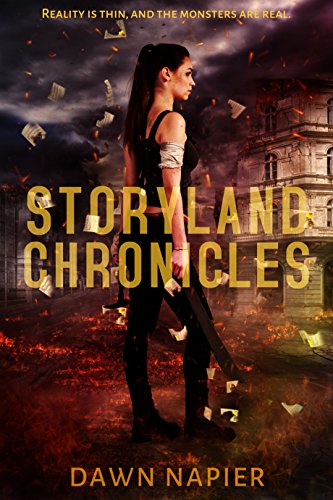
My first-ever published book, Storyland Chronicles (recently updated and rebooted with a bonus chapter), is free to download until Monday, March 30 at midnight. It’s a post-apoc about dragons and vampires and fairytale monsters. Bluebeard gets a cameo, Baba Yaga gets a cameo, and of course there are zombies because what’s a post-apoc without zombies. There might also be a unicorn. Don’t fuck with the unicorn.

Storyland: The Beginning

Thirty old men rode in the back of an eighteen-wheeled semi with the words WAL-CO across the trailer in bright blue letters. They sat cross-legged on the hard metal floor, their backs braced against the walls of the trailer. They rode in a silence that was almost terrified.

“I feel like a coward,” Senator Harrison said softly.

Gary Jamieson glanced at his younger colleague. Rob Harrison was a liberal, one of those idealist fuckers who believed his own hype. He’d only been in office a year and a half, not long enough to grow up. Typical, that he’d be the one to admit weakness.

“Don’t be like that,” someone said from further down the line. It sounded like Reed, but Jamieson couldn’t be sure. “If we don’t keep ourselves safe, the government will collapse and America will become another shithole like Africa and China. You heard what the monsters are doing to those folks.”

Harrison shook his head. “I know. I guess I’m just worried about my wife.”

“She’ll be fine. She’s better off down in the bunker than up here with us. Wish I could have stayed there.”

Harrison closed his eyes. He looked like he’d aged ten years in a week. Jamieson thought it was an improvement.

Jamieson closed his own eyes and thought about his wife, safely tucked away in the bunker with the rest of the women and children. His girlfriend should be there too, if she’d been able to keep clear of the monsters and make it there before the doors sealed shut. The “panic room” was entirely self-contained with its own power generator, clean water, and Internet. It would be no vacation, but they wouldn’t be at risk from those things that came out of the sky and out of the ground, those impossible things that looked like they’d jumped out of the pages of a fantasy novel but were horribly, murderously real.

Harrison said that he’d seen a dragon bite his neighbor’s head off. “He screamed and screamed—and then he stopped. The crunch—” He’d started to cry a little and had stopped talking. Jamieson didn’t blame him for being freaked out, but he still thought the young Democrat was a bit of a puss.

The semi was part of Operation KIM, or Keep It Moving. They didn’t know where the monsters had come from or who had sent them, so they were keeping the important members of the US government moving around to random locations. There were three other trucks out there somewhere identical to this one, carrying the rest of the Congressional body and the President himself. Only a select few knew where they were going or where they had been. The Congressmen themselves were not among them.

Right now they were headed for another bunker, one equipped with broadcasting equipment so they could continue to work and campaign. They didn’t know exactly where it was located, but rumor said somewhere in the southwest, like Arizona. Jamieson was looking forward to it.

Everything I’ve ever wanted to pass is going to happen in a heartbeat, he thought. We can outlaw abortion and birth control—the American population is at stake, ravaged by those horrible monsters. Reproduction is a responsibility, not a right. Martial law is already in effect, and we can keep it that way for as long as we want. No more bleeding hearts, no more gun control—and fuck protecting endangered species. Mother Nature’s not being too careful about protecting us these days, is she?

Jamieson dozed off with these pleasant thoughts running through his head. He never woke up again.

But something else did.

*****

The semi hit something hard, and the thirty odd men were tossed like a salad. One or two screamed; most cursed loudly, and Jamieson’s eyes flew open. They were rimmed with yellow.

“Reed, get on the horn and find out what that was!” Bellini shouted. “Are we off the highway already?” He saw that there was something strange about Jamieson’s eyes, but he barely noticed. His head and ass ached from the bump.

Reed glanced at his cell phone, but he shook his head. “Phone’s out,” he said. “Too shielded in here, I guess.”

“Well, where’s the comm line?” Bellini looked around. He’d been sitting in anxious silence for hours, and here was a chance to yell at someone about something, even if it turned out to be a stupid pothole.

“Jamieson has it,” Harrison said. “Jamieson, you okay?”

Jamieson did not answer. His eyes were yellow and filmy, and there was a green haze over his pupils. He stared straight ahead and neither blinked nor spoke.

“Jamieson’s sick, you guys,” Harrison said. “There’s something wrong with him.”

“Just take the phone out of his pocket,” Reed said. “It’s on the inside left. You can see the cord.”

“But what if what he’s got is contagious?”

“If it’s so contagious that you’ll get it just touching his coat, we’re all infected anyway,” Bellini said. “‘Case you hadn’t noticed, we’ve got almost no personal space in this box.”

Harrison did not look reassured, but he reached forward and tugged at Jamieson’s suit jacket.

Lightning-fast and almost imperceptible, Jamieson’s hand lashed out and caught Harrison’s wrist. Harrison shouted and pulled back, but Jamieson held on and lunged forward. His teeth fastened on Harrison’s face and pulled. Skin tore and blood poured, and Harrison screamed in pain.

Jamieson pulled off a sizeable chunk of Harrison’s cheek and chewed it—oh God he chewed it and swallowed it down like a dog with a biscuit. The other Congressmen were silent and baffled; they didn’t understand what they were looking at. But Harrison’s horrified face showed that he understood, and he struck out with his feet and free hand, trying to get clear of the monster that had once been a respected—though not liked—colleague.

Jamieson held on to Harrison’s wrist, and he gathered to his feet. He leaped onto the younger man and caught his flailing, striking fist. Harrison watched, his face slack with horror, as Jamieson opened his mouth impossibly wide. Jamieson’s jaw cracked and popped as it stretched like the maw of a snake and bit off two of Harrison’s fingers. Harrison shrieked and slammed his head against the metal floor of the trailer in a bid for freedom or unconsciousness. Then Jamieson seized Harrison’s hair and pinned his head to the floor, baring the senator’s neck. Harrison screamed louder and louder—and then fainter, foggier, bubbly and dying. Jamieson bit down and chewed.

Now the others understood, and they screamed too. But they were helpless old men, including twenty Republicans, and there was not even a single firearm among them. They scrambled back away from the spreading pool of blood, pushing and shoving and howling like trapped, dying dogs.

Bellini pulled a jackknife out of his pocket. He stepped around to Jamieson’s back, hoping that the monster was too busy eating to notice him. He opened the knife and then with a swoop and a prayer he swung and buried the knife to the hilt in Jamieson’s right eye.

The thing screamed and stumbled back, clawing at the knife with no apparent knowledge of how to pull it free. Bellini shouted in triumph and turned to the others, who were crammed into the far end of the trailer, just behind the cab. They stared at him with wide, frightened eyes. As if he were the monster.

The Jamieson thing was still thrashing, still living, but blood was pouring down its face and mingling with Harrison’s blood, soaking Harrison’s body. Its movements seem to be slowing. Maybe Bellini had succeeded in striking the brain. “It’s okay,” Bellini said. “Jamieson was—was sick. Or maybe he went crazy from the stress. I don’t know. But it’s okay now, because I stopped him. Right? I stopped him.”

Bellini stared at the group of elderly men, who were still and silent. The semi hit another bump, and most of them stumbled. A few fell to their knees. But some kept their feet, still and silent.

Their eyes were yellow and filmed with a dark-green haze.
Literally

                Brrriiiiiing!

                Sheila looked at the caller ID and sighed.  She loved her mother—she really did—but Mom was someone she could only enjoy in small doses, and only when she was fully awake and in control.  Right now it was early morning and the winter sun was blinding its way through her curtains, adding to her caffeine withdrawal headache.  She was not in the mood for this.

                But if she didn’t pick up the phone, Mom would keep calling.  Sheila could turn off the ringer, but the last time she’d done that Mom had left twelve frantic messages on her answering machine and eventually called the police to make sure she was still alive.  She’d given the police such a detailed scenario—down to the shattered skull and the kind of soap she’d slipped on—that they’d mistaken her fear for reality and had shattered the lock on her front door.  Sheila wasn’t sure who was more startled when they burst in to find her eating chips and reading a trashy romance novel in bed.

                Sheila couldn’t be too angry at her mother for that, though.  It had scored her half a dozen dates with the young and good-looking Officer Sandy.  He had an aunt with bipolar disorder, so they’d had a lot to talk about.

                Sheila sighed and pushed TALK.  “Hello?”

                “Hello Sheila, how are you?”  Trilling, grating, relentlessly cheerful.  Well, it was better than her other mode of greeting, which was a heavy sigh and a laundry list of grievances.

                “Hi mom.  How’s it going?”

                “Oh, I guess it’s going all right.  You know, I’m reading this new science fiction novel by that young guy you like so much.  It’s pretty unique.”

                “Isn’t that like being a little big pregnant?” Sheila asked.  Mom had been an English major before dropping out and marrying Sheila’s dad.  She ought to know better than to use “unique” with a modifier.  It was silly, but stuff like that grated in her ears like fingernails on a blackboard.

                “What?”

                “Never mind.  Tell me about the book.”  Sheila opened the cabinet over the stove, looking for the filters.

                “Well, like I said, it’s really unique.”  (Sheila ground her teeth.)  “It’s set on this desert planet, which I really liked because it was so cold last night.  I literally froze to death last night.”

                And there was that other thing she did that drove Sheila completely nuts: misuse of the word “literally.”  “If you literally froze to death, how are we having this conversation?”  Sheila knew she was being a bitch, but her head was pounding.  The sun was blinding her, and she couldn’t find the coffee filters.  She could get dressed and go buy some, but that would ruin her leisurely morning of watching cartoons and sipping coffee in her pajamas.  She was too crabby to be a good sport about her mother’s atrocious grammar.

                “Well, I don’t know how I’m talking to you sweetie, but I do know that I literally froze to death.  It was that cold.”

                “How did you freeze to death?  Don’t you have central heating in your apartment?”

                “Oh, I was so stupid.  I went out to get away from my neighbors, those two women who drink and fight all the time.  They were screaming at each other again, and something got broke—“

                “Broken,” Sheila muttered, but Mom didn’t hear her.

                “—and I just couldn’t handle it, and I went out.  I shouldn’t have done that, I was so stupid, I should have just called the police like I did the last time, but they must have known it was me because they both gave me the dirtiest looks for weeks afterward, and I couldn’t handle it again, so I went out and I got a bowl of chili at Bill’s…”

                Mom’s voice was rising and falling, reaching that strident pitch that still sent trickles of apprehension down Sheila’s back.  She was hitting the manic button, as Sheila’s father would say. 

                “Yeah, it was really cold last night,” Sheila interrupted, knowing that it was hopeless.  “The weather said that it got to thirty below.  Did you forget your good mittens?”

                “No, I had my mittens, but what happened was, I accidentally locked myself out.  I forgot my key, and I couldn’t get back in.  I buzzed the neighbors, but maybe they were fighting too loud or maybe they were passed-out drunk, or maybe they knew it was me and didn’t want to let me in.  Wouldn’t that be just shitty?  Isn’t it shitty, to know that I’m out there, literally freezing to death, and not letting me in?  What kind of people would do that, Sheila?”

                “I don’t know?” Sheila said.  She rubbed her face with her free hand.  Maybe she could just eat a spoonful of coffee grounds and get a buzz that way.  “So what did you end up doing?”

                “Well I started to head back to Bill’s to get warm and maybe have another cup of coffee, but I slipped on a patch of black ice.  The sidewalk hadn’t been salted, it’s so stupid to not put salt down, maybe I should sue the landlord but I don’t think I can now.  I hit my head and got dizzy and I guess I fell asleep, and that’s how I froze to death.”

                “Okay Mom, that’s really freaky,” Sheila said.  “Did you get frostbite?”

                “I might have, but it doesn’t hurt.  I froze to death, and now I can’t feel anything.”

                Sheila finally started to hear what her mother was telling her.  “Wait.  You’re telling me that you actually died last night?  You think that you’re dead?”

                “Well it’s the only thing that makes sense.  I fell down, I passed out, and when I woke up I was here.”

                This was a new delusion.  Usually it was related to someone looking at her wrong or plotting against her. 

                “Where’s here, Mom?” Sheila asked.  “Does it look like a hospital room?”

                “Noooo—it looks more like a library.  But the stacks are so high I can’t see the ceiling.  And I can’t find the circulation desk.”

                “But you still have your cell phone with you?”

                “Oh—I probably shouldn’t be talking to you here, should I?  Libraries usually have rules about talking on the phone.  They want you to only use them in the lobby.  But I can’t find the lobby either.  Just books and books and books.”

                “Sounds like you’re in heaven.”  Sheila smiled.  If she was going to imagine herself going anywhere after death, it would be to a never-ending library.  She and Mom had that much in common.

                “I don’t know where I am, but there’s someone coming so I’ll call you back.”

                Click.

                Sheila looked at the phone in her hand then put it down slowly.  That was definitely one of the stranger conversations she’d had, with her mother or anyone.

                Sheila was reluctantly dressed and heading for the door—she really needed those coffee filters, there weren’t even any paper towels that she could use—when the phone rang again.  “Please don’t let it be Mom again,” she said aloud as she went for it.

                It wasn’t Mom.  It was Officer Sandy.  “Hi—Sheila?” he said.

                “Yeah babe, what’s going on?”  Sheila grinned. 

                “Sheila hun, I have some really bad news.  It’s about your mom.”

                Ten seconds later, Sheila dropped the phone.

                After the funeral, Sheila stopped at the Book Nook and found the sci-fi novel Mom had been reading when she died.

                It was pretty unique.

Grasshopper Tale

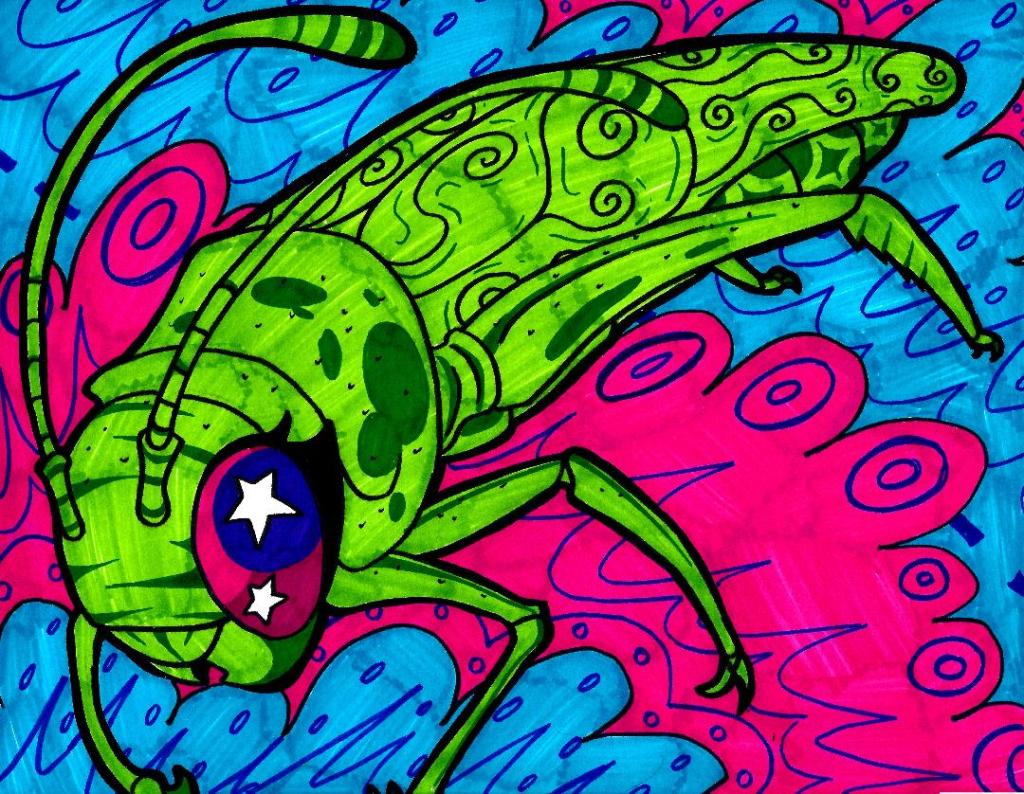
Artwork courtesy of Leia Napier, Copyright 2020. Used with permission

As fairy tales go, it isn’t much.

Nobody will make an epic trilogy out of it.  Michael Bay will never pick up the option.  My story will never have been brought to you by Generation X Toilet Paper—For When Your Life Is In The Crapper.

But it’s my story, and I’m proud of it.

If you want to go all the way back to the beginning, I’d have to start with my childhood and all the time I spent catching frogs and watching bugs in the lake near my house.  If I were the sensitive, tea-drinking sort I could wax poetic for a couple of pages about my hippie parents and how they instilled a respect for nature into the essence of my soul.  Enture chapters could be dedicated to the tears I shed over missing pets and roadkill and the nest of rabbits our cocker spaniel found and shredded.

But this fairy tale isn’t about any of that.  It’s about the day I was nice to a grasshopper.

I was on my way to work.  I’d just been told that Friday would be my last day in the warehouse, and I was thinking gloomy thoughts.  This was actually an improvement.  The day before, when I’d first gotten the news, my thoughts had been frantic and terrified, the sort of trapped-rat thoughts that bite and tear at you until you scream or put your fist through something just to make it stop.  But that had passed, and now I was just tired and depressed.  We’d have to go on welfare.  State insurance.  The kids wouldn’t get much for their birthdays this year.  Life was going to suck.

It was muggy and hot, and I had the windows rolled down to save air conditioning.  I slowed to a crawl as I approached a construction site, and I rested my arm on the door.  Something tickled it.

I jerked my arm inside the car, thinking spider.  But instead I saw an enormous emerald-hued grasshopper about three inches long.  It clung to the door frame where my elbow had been, and its antennae twitched.

I was on a four-lane road with a wide median.  If I knocked him out of the car now, he’d get squished for sure.  I kept my left arm tucked in the car as I inched past the construction area.

“Better hold on tight, little G,” I told the bug.  “It’s about to get hairy.”  Slowly I left the construction area behind and accelerated back to cruising speed.

The grasshopper flatted out, and his length went from three inches to almost five.  Then he began to creep forward.

“I don’t know if that’s a good idea, dude,” I said.  It was hard to watch the road with this huge bug taking up my attention.  “You need to hold on with all six.”

But the grasshopper kept moving, and soon he’d crept onto the arm of my rear view mirror.  Now he was protected from the wind on three sides, and I relaxed a little.  “Good call, little man,” I said.  “Stay there until we get to the warehouse, okay?  There’s a field right next to it where you’ll be safe from us dumbass humans.”

I could finally concentrate on my driving.  Traffic was light, since I worked a weird late-morning-to-early-evening shift.  I always missed the worst of the rush hour traffic, both coming and going.  Something else I was going to miss.  My next job would probably be eight to five.

I was going to miss a lot about my job.  It wasn’t the best-paying in the world, but the hours were good and the people were decent.  My next job might be another good one, or maybe I’d be stuck working with a bunch of racist assholes like my first job.  There was no way of knowing.  That jittery, trapped-rat feeling was back. I’ve always hated not knowing what to expect. Unhappiness was preferably to uncertainty.

I came to a stop sign and drummed my fingers on the wheel.  My radio was broken, and I couldn’t afford a replacement.  Some music would be good right now.  Anything to distract me from what was coming in three more days.

I saw the grasshopper creeping out of his safe nook.  “Oh, hey, don’t do that,” I said.  “We’re still on the road.  You’re going to get blown away.”

The insect paid me no mind and proceeded to stalk slowly to the top of my mirror.  If I tried to shoo him back, he’d jump away—straight into the middle lane of a busy intersection.  I made my turn, accelerated very slowly, and hoped for the best.

The wind picked up, ruffling the grasshopper’s wings.  My eyes flicked back and forth between the road and the insect, and I prayed that nothing would happen that required lightning reflexes.  That would be a hell of a thing to write on my tombstone:  DISTRACTED BY A BUG.  The kids would do that just to be smart. They had a weird sense of humor.

Finally the wind overcame the grasshopper’s considerable strength and blew him off—straight into my car.  “Fuck!” I screamed.  He blew past me; he was behind me somewhere.  Maybe on the back of my seat.  I leaned forward and slowed down, probably pissing off the teenager in the coupe behind me.  He tailgated me so hard I couldn’t see his headlights.  I slowed down a little more just to be a dick and ignored him.

“Please don’t be on my back, please don’t be on my back.”  I never minded bugs, as long as their legs didn’t touch me.  That was the dealbreaker.  If I felt long, hairy grasshopper legs crawling on my neck, I could not guarantee its safety—or mine.

But there was the warehouse, and I pulled in with relief so great I almost pissed myself.  I found a spot next to the little meadow and got out.  I couldn’t leave the windows down, or someone would steal everything in my car that wasn’t nailed down.  And if I rolled up the windows the grasshopper would bake.  So my final leg in this commute of the damned was to find the grasshopper and shoo it out of my car.  I found a fast food cup and pried the lid off.

The grasshopper was perched on top of my head rest, for all the world as though he was checking out the view.  I nudged him with the cup, he gave a mighty HOP—and then he was gone.

I checked the pavement behind me, but there was no sign of the little guy.  I searched my car very thoroughly, verifying that he hadn’t hidden in the garbage somewhere, and finally I rolled up my windows and locked my doors.  I didn’t need to be late for work today.  Now while I desperately needed a good reference.

So that’s what happened.  Not much of a fairy story.  But the interesting part is what happened after.

My daughter took it into her head to plant a vegetable garden in the back yard, to save money on groceries.  Edamame, green beans, tomatoes, and summer squash.  And every single crop took off like gangbusters; they flowered and fruited weeks ahead of schedule, and they produced like a machine was just running them off.  My daughter has been having the time of her life back there.  She loves feeling useful.

And in the four months since she planted, there hasn’t been a single insect in the entire garden.  She’s never been bitten by a mosquito while weeding, and not one leaf has been nibbled.  Everyone’s jealous of our tomatoes, which are the size of softballs, and our neighbor Nate has threatened to torch our house if we don’t give up our secrets.

I don’t know what to tell him.

Big Spider, Mama

Marcia took her daughter to the playground on the corner at least twice a week. It was a sanity-saver, a chance to sit and zone out for an hour or two while Caylee ran around and wore herself out. There were a few other women, also stay-at-home-moms. Their children were around Caylee’s age, between three and five, a good dynamic. The moms swapped birth stories and husband stories, teething stories and sleeping through the night stories, as their pack of preschoolers ran together like puppies. They clambered over the equipment and over each other, announcing, “I’m Batman!” and “I’m a princess!” Caylee, in the spirit of gender equality, was Princess Batman.

Marcia loved taking Caylee to the park, where her daughter could get dirty and tired with minimal effort from Marcia herself. But she wasn’t sure what to think about some of the other mothers there. When they weren’t gossiping about their husbands, they were gossiping about each other. Nobody was singled out specifically. Whoever didn’t show up that day was fair game. Marcia always dreaded returning after a long weekend, when eyes were extra-big and smiles were extra-friendly.

The children, four or five of them today, were digging in the sand pit on the far edge of the playground. Caylee’s arms and legs were filthy with damp sand, and her eyes were alive with the thrill of exploration. Marcia loved that look.

“Stacy’s taking her son to the doctor for his four-year checkup today,” Carla announced to the group. “That’s why she’s not here.”

“Are there any shots at the four year?” Marcia asked. Caylee was going to hers next week.

“I think there are a couple of boosters,” Crystal put in. “But it doesn’t matter in Stacy’s case. She doesn’t vaccinate, you know.”

A collective murmur, and a few rolled eyes. “I’m always shocked when I hear about someone like that,” Dana said. “I don’t know why, they’re everywhere.”

“She’s done a few vaccinations,” Marcia said. “Just not the chicken pox, and I think hepatitis.”

“People like that are the reason whooping cough and measles are making a comeback,” Tammy sighed. “They endanger everyone’s kids, not just their own.”

Marcia had no love for people who didn’t vaccinate for non-medical reasons, but this collective cattiness was making her ill. Everyone nodded and smiled when Stacy mentioned her son’s selective vaccination schedule, but now that she was AWOL, they made her sound like Typhoid Mary.

The group of children was moving further away, out of the sand and into the grassy area next to the hedge. Caylee squatted down and peered into the neatly trimmed bush. Then she jumped back and came running to Marcia.

“A spider! A big spider over there!” Caylee pointed back at the hedge. The other children were backing away slowly. One little boy turned and ran for the monkey bars.

“They can get pretty big,” Marcia said. “What color is it?”

“Black. And brown. It’s big.” Caylee’s eyes were wide. “Go squish it Mama?”

“Just leave it alone. Go play somewhere else if you’re afraid of it. When we get home, we’ll look up spiders on Mommy’s computer and maybe we’ll find out what kind you saw.”

“Let’s go home now.” Caylee tugged at Marcia’s hand. Marcia looked at her companions with a bewildered shrug.

“I guess this is goodbye,” she said. “See you.” And she let Caylee lead her by the hand out of the park.

That will take the focus off of Stacy, anyway, Marcia thought. They’ll spend the next twenty minutes discussing how I let my daughter call the shots and boss me around.

It was three days before they made it back to the park, and for once Caylee didn’t seem eager to go. Marcia had looked up spiders on several image searches, but they had been unable to identify Caylee’s “real big spider.” It wasn’t a black widow or a fiddleback, so Marcia wasn’t too concerned, but Caylee whimpered and clung to Marcia whenever she mentioned going back to the park to look for it again. This was not Caylee-typical behavior.

Caylee had even dreamed about it. The night following their last visit to the park, she had awoke screaming, “Red eyes! Big spider Mama, with red eyes!” Marcia had soothed her by climbing into bed with her until she fell asleep again. David had scolded her for it, and Marcia felt obligingly guilty, but the child had been completely terrified. Marcia knew the difference between real fear and a play for attention.

Caylee walked so slowly down the sidewalk that Marcia felt like she was pulling her daughter along. “Are you tired?” she asked. Maybe Caylee was getting sick.

“Scared,” Caylee said. “There’s a big spider.”

They were now at the park, and Marcia was getting exasperated. “All right, show me this big scary spider,” she said. “It’s probably not even there anymore.”

They passed the park bench where Stacy and Dana were sitting. “Hey, have you seen Robert?” Stacy asked. “I seem to have lost him.”

“No, but we’re on our way to look at a big spider,” Marcia said. “We can look for Robert at the same time. Come on.”

Stacy got up and followed Marcia to the open, grassy area and the bordering hedge. As they approached, Marcia saw what looked like snow, covering the hedge like white lace. As they got closer, Marcia recognized the thick substance as a spider’s web.

It covered the whole hedge from top to bottom. Marcia stopped walking. Caylee clung to her leg, and she could feel the little girl shaking. This really was a big spider. Or a whole nest of them.

Caylee’s grip on her leg tightened, and she whimpered. “Scary spider,” she whispered. “It’s big.”

Marcia didn’t want to get any closer. The web was enormous, like a fluffy cotton blanket. But she didn’t want to encourage Caylee’s phobia by adding to it. What was the right thing to do here?

Stacy came up behind her and hunkered down. Marcia had completely forgotten about the woman. Stacy peered through a shadowy gap in the bottom of the hedge. Marcia tried to look, but all she could see beyond the hedge were some vague white humps. More webbing, she thought.

Stacy screamed. “Robert!” And she dashed forward, into the whiteness.

The hedge exploded in a violent eruption of long legs and blood-red eyes. Stacy screamed louder, shrieked, howled in fear and agony, and then a sickening crunch and her screams were over.

Marcia saw none of this. She had scooped Caylee into her arms and was running out of the park, sobbing with fear and trying not to scream herself. Caylee’s wet face pressed into her neck, and she cried out. “Big spider, mama, really big!”

The Five Stages of Editing

Everyone talks about how hard and lonely a job it is to be a writer. Maybe I’m just a freak of nature, but I don’t get it. How can I be lonely when I’m writing? I’m surrounded by amazing people, and they all have stories to tell that keep me up all night. And it’s fun. In what other job can I create entire universes out of the air, make them move and dance to my whim, and blow them up when I’m having a bad day?

But there’s one part that I do hate with all my heart and soul, and that’s the editing process. That part is both hard and lonely, not to mention exhausting and heartbreaking. It’s an emotional rollercoaster not unlike the five stages of grief. I call it the Five Stages of Editing.

Stage One: Shock. I always let my work marinate for a few weeks before going back to work on it, and I am invariably horror-struck by how badly written it is. Grammatical errors! Adverbs in dialogue attribution! Overuse of the phrase “the fact that”! Oh God, this thing blows like a wind tunnel.

Frequent activities during this stage include drinking, surfing the Net, and picking fights with my husband—fights that usually begin with the question, “Do you still think I’m pretty?”

Stage Two: Depression. I’ll never make this piece of crap readable. I’ve been wasting my time. Maybe I’m wasting my life. How will I ever rub elbows with legends like Stephen King and Brian Keene if I don’t even know the difference between lie and lay? I’ll have to die a horrible booze-soaked death if I ever want to see my name in print.

Frequent activities include drinking heavily, watching way too much TV, and getting maudlin over life insurance commercials. Any mention of the passage of time, getting older, or lifelong regrets is likely to induce an hour’s worth of PMS-like weeping. My children seem to find this stage the most disconcerting, maybe because I have been known to clutch them to my bosom and whimper, “I regret NOTHING!”

Stage Three: Renewed Hope. This stage is one of the most bittersweet. It can usually be induced by reading a chapter or two from an extremely poorly written bestseller. Opinions vary, but I personally recommend Fifty Shades, Flowers in the Attic, or any of the Twilight books. The trick to reaching this stage is to realize that I don’t have to be Ernest Hemingway; anyone has a chance. Anyone.

Now that I’m back in the game, my only activity aside from actually editing the damn novel is posting on various Internet forums about the unfairness of the publishing world. “How can that crap be a bestseller? Why do so many people have the literary taste of a grasshopper?” This sort of post gets great responses on indie author forums.

Stage Four: Determination. I will quit my day job, and I will make a living at this. Bitches better get out of my way, because this bitch is back and taking no prisoners—and hey where’s the coffee? My head is KILLING me.

Frequent activities include editing, drinking coffee by the pot, and swearing on heaven and hell and everything in between that it is going to happen for me this time. Scrapbook full of rejection slips be damned, full speed ahead!

Stage Five: Pride. This is when it’s time to pass around the Xerox copies, email the pdf, and read the work aloud to my writing group. I am one crazy sexy writing mama, and I want the world to know it! I did a bang-up job, hell yes I did, and if the stuffy Establishment chooses to reject me again, that’s their loss. Those dipshits accepted Twilight, so what do they know anyway?

Eventually, emotional equilibrium is reached, and life returns to normal. Then I start submitting my work to publishers, cross my fingers, and the rollercoaster starts all over again.

Little Dead Girl

Tim drove through the neat Chicago suburb, and the dead girl rode in the back seat.

She was about six years old, chubby and red-haired. Tim never saw her face to face. She only appeared in his rear view mirror. Sometimes in the mirror of a gas station bathroom. Tim would be washing his hands, thinking of nothing at all, and there she would be. That solemn little face, framed by ginger curls. But mostly she rode in his back seat, calm and quiet. A good little girl. Usually she sat still as death, staring straight ahead like a pale statue, but this time she was playing some sort of game with her fingers, twisting them like little pale snakes. She watched her own fingers twist in her lap, as though they moved of their own accord.

Tim turned around in his seat and looked behind him. As usual, there was nothing to see. Just cheap grey interior. He turned back around, looked in his rearview mirror—there she was. It was always the same.

The dealer told me this piece of crap was brand new, he thought for the hundredth time. I bought it new. Lying son of a bitch.

He’d noticed the 173 on the odometer, but the dealer had insisted that it was just from “the guy” driving it from another dealership. Tim should have insisted on a pre-owned-vehicle price rate. He should have walked out of the fucking dealership when that grinning bastard showed him this stupid little cracker box clown car and told him that this was all that the bank had approved. But Tim had been tired, cranky, and nervous about going another week without wheels. He’d accepted the fucking clown car, and to add injury to insult it came with a free dead kid.

“How’s it going back there?” Tim asked, with the fake cheeriness that was the domain of those who have next to no experience talking to children.

The little girl glanced at him and said nothing. She didn’t talk much. “Yes,” “No,” and “Fine” were the sum of her vocabulary. Tim wondered if the kid had been retarded when she was alive. She shouldn’t still be retarded after death. She was all spirit, so she had no brain to be damaged, right?

“Could be worse, I suppose,” Time said aloud, thinking of a road trip he’d once taken with his sister and her brats. “At least you don’t need to stop and pee every two miles.”

The girl still said nothing. Her hair was curly and ginger-orange, and her face was almost porcelain-fair. No freckles. Gingers usually had lots of freckles. Her only signs of nonlife were a single drop of blood below one nostril, and a dark bruise on the upper left side of her face. Her injuries weren’t horrible, not gruesome like in those terrible evil-ghost movies. But they troubled the eye and mind nevertheless. They were so calmly final. Tim couldn’t stop looking at that single drop of dark blood, the blue-black bruise. That’s what death looks like, in the end, he thought. Like nothing much.

“Do you remember how you died?” Tim asked. This wasn’t the first time he’d asked this question, and he wasn’t expecting a response.

“Big white car,” the girl said softly, still playing with her fingers. She watched them intently, like a child watching television. “I saw a big white car, and it got bigger and bigger.”

Her gentle singsong voice sent a chill down Tim’s neck. This was the most he’d ever heard her say, and he wished he hadn’t asked.

Tim wasn’t driving a big car by any stretch, but that meant nothing. To a little girl in the middle of the road, even a SmartCar would look like a Mack Truck.

So what had happened? “The guy” might have hit her while driving it down from that mysterious other dealership. Or… What if the car had been bought once before, and the previous owner had hit the kid shortly after buying it? Couple of days, maybe a week, however long it took to put 170 miles on it. Then he freaked out and brought it back, and the dealer had turned around and re-sold it without thinking twice.

Of course a car that had been involved in a death would have been impounded by the police. But what if it was a hit and run? No witnesses around, so the driver took off. And then returned the car to try to get rid of the evidence. How much damage would a little kid do to a car? Was it something that the dealer would have noticed?

“Did you see the person driving the car?” Tim asked.

“No.”

So much for that. Tim racked his brain for ways to figure out who the girl was and who had killed her. “What town did you live in?” he asked.

“Lake Park,” the girl said. She up looked at him for a moment, studying him, before turning to the window and staring out. Her fingers twisted like white worms in her lap.

Tim was driving through Lake Park right now. His apartment was on the edge of town.

The dealer had lied through his motherfucking teeth. This car hadn’t been driven here from some remote location. Tim’s stomach roiled with anger.

“Do you know your street address?” he asked.

“1112 Hickory Street,” she repeated blandly.

That was about four blocks west of here. Tim considered stopping by the house. But what would he say? “Sorry about your daughter. By the way, she’s been haunting my car for the last month and a half.” They would think he was a lunatic, or some sicko who got off on upsetting bereaved people. At best, they’d slam the door in his face. At worst, he’d have some hard questions to answer at the police station.

Tim kept driving. Unless he could identify the car’s previous owner, there was just no point.

He stopped at a red light, and an idea came. The dealership would have the previous owner’s name on file. Tim could ask for a vehicle history report and get it that way. But the dealer had already lied and said that Tim was the car’s first owner. Tim would have to concoct something to get the guy to tell him the truth.

Or… He could take the car to a mechanic and find out if the car had been involved in an accident. They could figure out all sorts of things by examining the framework of the car, he’d heard. He could also go to the police and find out if there was an unsolved hit and run on their record. It was odd that he hadn’t seen anything like it on the news. Lake Park wasn’t a big town, and a kid getting hit by a car would have made headlines.

He glanced into the rearview mirror. The little girl was staring straight at him, and blood was running out of both nostrils like fresh snot. Tim shivered and looked past her, at the pretty brunette on the crotch-rocket motorcycle behind him. She was wearing a black windbreaker, and her helmet was flame-red, like her motorcycle. Her shirt under the jacket was very loose. She wasn’t wearing a bra. Tim could almost see—

The brunette saw him, smiled, and blipped her horn.

Tim turned around and saw that the light was green. He hit the gas and peeled forward.

The was a little girl crossing the street in front of him.

She had curly red hair and pale, chubby cheeks. Tim didn’t have time to stop. He slammed on his brakes, but it did no good.

She never even looked up. There was a small, terrible thud.

He looked into the rearview mirror. The little girl stared back. Her face was covered with blood, and it was soaking into her dress.

Slowly, she faded away.